
[4/6] The hidden pattern Google uses to classify your site
Why framing matters more than keywords

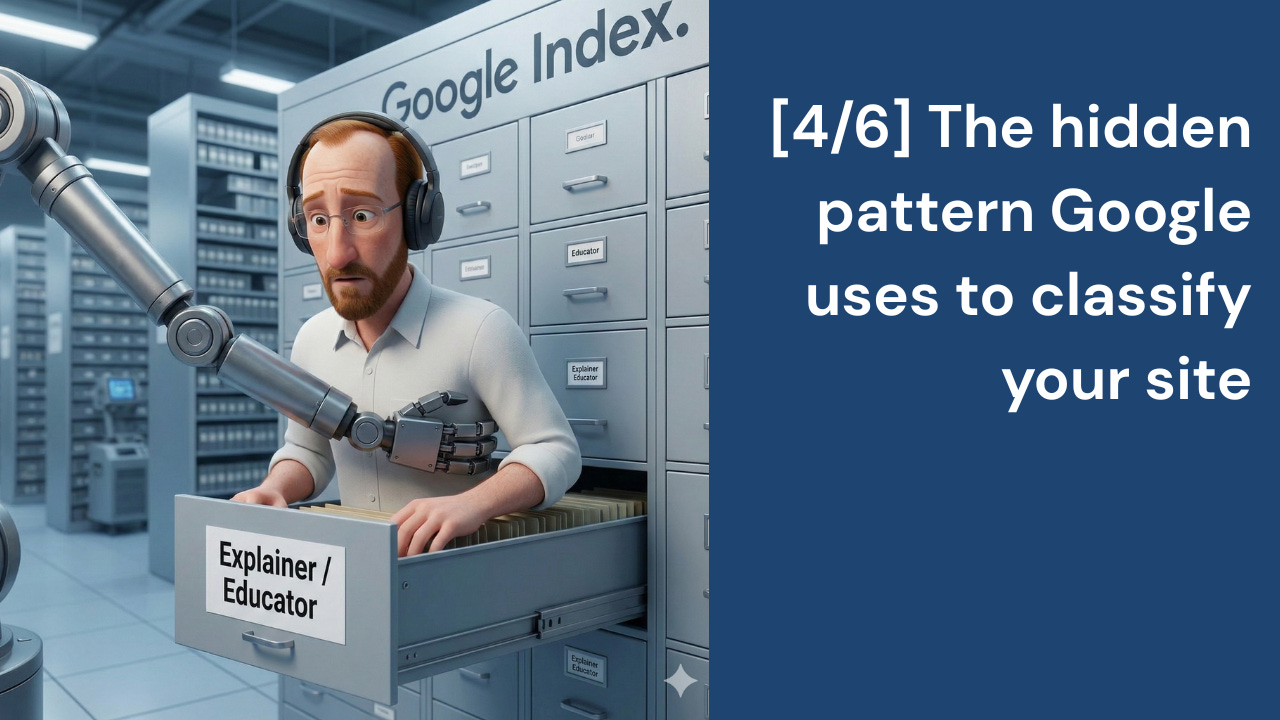
In the last episode, I left you with a question that sounds philosophical but isn’t:
If Google doesn’t actually understand intent…
how does it infer what your site is about and what role it should play?
The answer is simpler (and more mechanical) than most people expect.
Google doesn’t read. It correlates.
Search engines don’t interpret content the way humans do.
They don’t reason.
They don’t get nuance.
They don’t recognize strategy.
Instead, they observe patterns at scale.
Google looks at millions of pages and learns things like:
Pages that talk about X often also talk about Y
Sites that link this way tend to behave like that
Sources that rank here usually publish this kind of content
Meaning emerges statistically.
Not from comprehension, but from co-occurrence.
How context is actually inferred
Google builds its picture of your site through a few repeatable signals:
1. Topic bundles
What topics repeatedly appear together across your site?
Not just keywords but concepts.
Google learns:
‘This site usually discusses these things in relation to each other.’
That relationship matters more than any single term.
2. Internal linking hierarchy
More than just passing authority, internal links communicate:
What explains what
What supports what
What is central vs. peripheral
In other words, internal linking teaches Google how your ideas are structured.
This is why random cross-linking weakens clarity and why hub-and-spoke models work when they’re intentional.
3. Clustering and proximity
Rather than living in isolation, pages live in:
Directories
Link neighborhoods
Semantic clusters
A page inherits context from the pages around it.
Same article, different cluster → different interpretation.
Why framing beats wording
Here’s what most teams miss:
You can use the same keywords and write about the same topic
And still send a completely different signal.
Because Google isn’t counting phrases.
It’s observing how problems are framed repeatedly.
Do you:
Teach execution?
Compare options?
Analyze trade-offs?
Evaluate performance?
Over time, that framing becomes your statistical identity.
This also explains AI search behavior
LLM-powered systems work the same way.
When deciding:
Which sources to retrieve
Which to cite
Which to trust
They favor sources that are:
Predictable
Consistent
Role-stable
Because they’re easier to rely on.
The uncomfortable part
Once you see this, something clicks:
Google doesn’t need to know your intent. It only needs to be confident about your behavior.
Which leads to a final, awkward question:
If consistency and role clarity matter this much…
Why do some sites seem to rank for everything anyway?
And why does copying them almost always fail?
That’s what we’ll tackle next.
Darrell the semantic SEO dad
PS. These deep dives are powered by curiosity, caffeine, and questionable sleep habits. Want to sponsor the caffeine part? ☕️
A clear and practical breakdown showing that Google rewards consistent framing and site structure over keywords, emphasizing behavior and context as the real drivers of search visibility